00 engagement
01 problem
Evaluating driver handoff and autonomous steering interactions needs realistic tactile feedback. Static digital screen prototypes cannot convey physical steering wheel torque or emergency hazard resistance, and dedicated automotive simulation testbeds are too slow to reconfigure for early UX testing.
02 approach
Configured an Arduino-based physical trigger switch to initiate autonomous driving test scenarios over serial communication.
Built a custom Node.js middleware bridge plugin integrating serialport, Socket.IO, and native DirectInput force feedback wrappers.
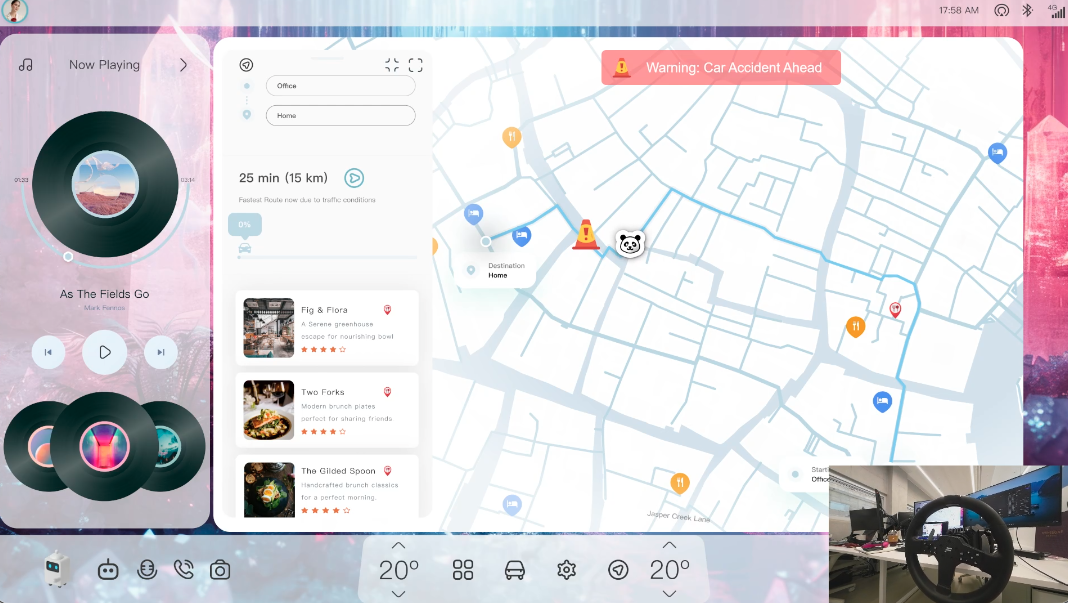
Designed the autonomous cluster UI in ProtoPie Studio with dynamic route navigation, lane-centering state changes, and visual hazard warnings.
Linked ProtoPie timeline cues to send real-time steering angle offsets and high-frequency force feedback rumble alerts to the Fanatec wheel base.
03 stack
04 outcome
The testbed proved that designers can prototype and evaluate physical autonomous driving mechanics (including motorized self-steering and haptic hazard warnings) using off-the-shelf sim-racing hardware synced directly to ProtoPie. That removes the need for custom vehicle firmware in early design phases.